
Key takeaways
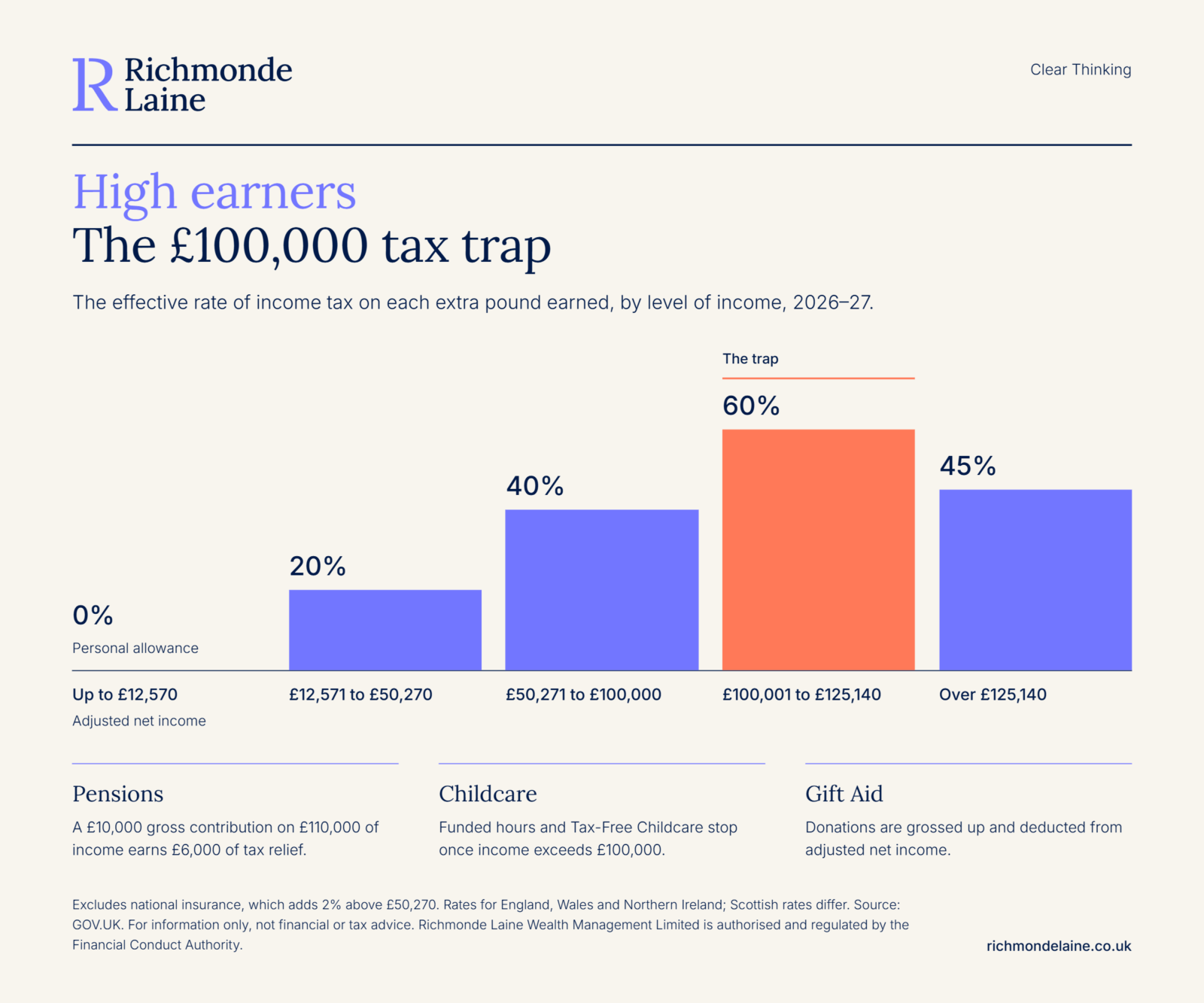
The effective rate is 60%: between £100,000 and £125,140, every £1 earned costs 60p in income tax, or 62p with national insurance.
The personal allowance disappears: it falls by £1 for every £2 of adjusted net income above £100,000, vanishing entirely at £125,140.
Childcare support stops at £100,000: families can lose free childcare hours and Tax-Free Childcare by earning a single pound too much.
Pensions are the main remedy: contributions reduce adjusted net income, effectively earning 60% tax relief in the trap.
Salary sacrifice adds more: it also saves national insurance, although that saving is capped at £2,000 a year from April 2029.
Gift Aid and timing help too: charitable donations and careful timing of bonuses can also bring income back below the threshold.
Introduction
A pay rise is supposed to be good news. For a growing number of professionals, the one that takes their income past £100,000 brings an unwelcome surprise: a marginal tax rate higher than anything paid by those earning far more. The cause is an obscure but costly rule, introduced in 2010 and never indexed since, that withdraws the tax-free personal allowance from high earners.¹
With income tax thresholds frozen until April 2031,² ordinary pay rises are pulling more people into this band every year. For parents of young children, the cost can be higher still, because valuable childcare support stops abruptly at the same point. The trap is not inevitable, however. What follows explains how it works, who it catches and the most effective ways out.
Who gets caught?
The trap catches people whose income sits just above £100,000, often only for a year or two. Common examples include:
- Senior employees: salaries in the low six figures, especially in London and the South East.
- Bonus recipients: a one-off bonus or share award can push income into the band for a single year.
- Parents of young children: who also risk losing childcare support at the same threshold.
- The self-employed and partners: whose profits fluctuate from year to year.
- Savers and landlords: because interest, dividends and rental income all count towards the total.
Many are surprised to learn they are affected at all, because the higher tax appears nowhere on a payslip as a separate rate.
How the trap works
The personal allowance of £12,570 is reduced by £1 for every £2 of adjusted net income above £100,000, so it disappears entirely at £125,140.¹ Within that band, each extra £2 of income is taxed at 40% and also removes £1 of allowance, which is then taxed at 40% too. The result is an effective income tax rate of 60%. Employees and the self-employed also pay 2% national insurance at this level, taking the marginal rate to 62%.
Once income passes £125,140, the effective rate falls back to the 45% additional rate. Losing the whole allowance costs £5,028 a year in extra tax. Scottish taxpayers face a higher effective rate, because Scotland’s income tax bands differ.
The childcare cliff edge
For parents, the bigger cost may lie in childcare. Working families in England lose funded childcare hours if either parent’s adjusted net income is expected to exceed £100,000 in the tax year,³ and Tax-Free Childcare uses the same test.⁴
Unlike the tax taper, this is a cliff edge. A single pound of income above the limit can remove support worth several thousand pounds a year for a family with young children. That makes it doubly important for parents to estimate their income early in the tax year, and to act before it ends.
Pensions: the most effective way out
Adjusted net income is total taxable income less certain reliefs, including the gross value of personal pension contributions made under relief at source.⁵ A contribution large enough to bring adjusted net income back to £100,000 restores the allowance in full.
Consider someone earning £110,000 who pays £8,000 into a personal pension. The provider adds £2,000 of basic-rate relief, making a gross contribution of £10,000. Their adjusted net income falls to £100,000, restoring £5,000 of personal allowance, and higher-rate relief is claimed through self-assessment. In total, £6,000 of tax relief is received on £10,000 placed in the pension: an effective 60%.
Salary sacrifice goes further, because the salary given up also escapes national insurance. From 6 April 2029, however, the national insurance saving will apply only to the first £2,000 sacrificed each year; income tax relief is unaffected.⁶
Other ways out
Pensions are not the only lever.
- Gift Aid: donations are grossed up and deducted from adjusted net income, so a £4,000 donation reduces it by £5,000.⁵
- Bonus sacrifice: many employers allow a bonus to be paid into the pension instead, avoiding income tax and, within limits, national insurance.
- Timing: where income is flexible, as for many business owners and the self-employed, spreading it across tax years can keep each year below the threshold.
- Savings income: interest and dividends count towards adjusted net income, so holding savings in ISAs, or in a lower-earning spouse’s name, can help.
What to watch
Remedies need to fit the wider plan. Pension contributions lock money away until retirement, and the minimum age for access rises to 57 in 2028, so they suit those with enough accessible savings. Large contributions must also fit within the annual allowance, including any unused allowance carried forward from the previous three years.
Some popular investments do not help. Enterprise Investment Scheme and venture capital trust investments offer income tax relief, but they do not reduce adjusted net income, so they do not restore the allowance. And because the test applies to the whole tax year, decisions are best made with a reliable estimate of total income well before 5 April.
Escaping the trap
The £100,000 trap is the product of a threshold left untouched for more than 15 years, not of any deliberate design to tax the comfortably off more heavily than the very rich. Until it is reformed, it rewards those who plan. For most people caught by it, a well-timed pension contribution is the simplest and most valuable step; for parents, acting before the tax year ends can preserve childcare support worth even more. The key is to know your likely income early, while there is still time to act.


This article is for general information only and is not financial, tax or legal advice. Figures reflect the rules in force on 03 November 2026 and may change.
The effective 60% income tax rate on income between £100,000 and £125,140, caused by the gradual withdrawal of the personal allowance.¹
It starts when adjusted net income exceeds £100,000 and ends at £125,140, when the personal allowance has gone entirely. Above that, the 45% additional rate applies.¹
No. Only income within the band suffers the 60% effective rate. Income below £100,000 is taxed at the usual rates.
Enough to reduce adjusted net income to £100,000. For someone earning £110,000, that means a gross contribution of £10,000, or £8,000 paid personally under relief at source.
Usually, because it saves national insurance as well as income tax. From April 2029, the national insurance saving will be capped at £2,000 of sacrificed salary a year.⁶
Possibly. Funded childcare hours in England and Tax-Free Childcare are both lost if either parent’s adjusted net income exceeds £100,000.³ ⁴
Yes. Bonuses, share awards taxed as income, and savings and investment income all count. Paying a bonus into a pension can bring income back below the threshold.
Yes, because the personal allowance applies across the UK. Scottish taxpayers face a higher effective rate, however, because Scotland’s income tax bands differ.
Sources & Notes
2. Macfarlanes, The Autumn Budget 2026, 28 October 2026.
4. Best Start in Life (Department for Education), Eligibility for Tax-Free Childcare.
5. HMRC, Personal Allowances: adjusted net income.