
Key takeaways
Shares follow the will, not the business plan: without an agreement, a deceased owner’s shares pass to their family, who may have very different interests.
Three elements work together: an agreement setting out who buys the shares, insurance to fund the purchase and a sensible valuation.
Options protect business relief: a cross-option agreement usually preserves inheritance tax business relief, whereas a binding obligation to buy and sell can lose it.
Trusts keep money where it is needed: policies written under a business trust pay the surviving owners, not the deceased’s estate.
Partnerships need it too: partnership agreements should say what happens to a partner’s share, and how it will be paid for.
Arrangements go stale: cover should be reviewed whenever the business’s value, ownership or partners change.
Introduction
Most business owners spend years planning for growth and very little time planning for the day a co-owner is no longer there. It is an understandable omission. Few people enjoy contemplating the death or serious illness of a colleague, still less their own. Yet for a company with two or more shareholder-directors, or a partnership of any size, the question of who would own a departed colleague’s stake is one of the most consequential a business can face.
Without a plan, the answer is usually unhelpful to everyone. The shares pass to the deceased’s family, who may need cash rather than a minority stake in a private company, while the surviving owners may lack the money to buy them. Shareholder protection is the arrangement that resolves this tension. What follows explains how it works, how it is taxed and how to set it up well.
Who needs shareholder protection?
Shareholder protection matters most where ownership and management overlap. Typical candidates include:
- Owner-managed companies: two or more shareholder-directors who run the business day to day.
- Partnerships and LLPs: professional practices where each partner’s share is valuable and illiquid.
- Family businesses: where shares may pass to relatives who are not involved in the business.
- Businesses with external investors: where shareholders’ agreements already restrict who may hold shares.
The common thread is a stake that is valuable on paper but hard to sell, held by people whose families depend on it.
What happens without a plan?
When a shareholder dies, their shares form part of their estate and pass under their will or the intestacy rules. Their family inherits an asset they may not want, cannot easily sell and may not fully understand. The surviving directors, meanwhile, gain a new co-owner with votes, dividend rights and, often, a pressing need for cash.
Both sides are exposed. The family may have to accept a low price, or wait years for any value. The survivors may find control diluted and decisions contested. Few businesses have the spare cash to buy out a substantial stake at short notice, and borrowing at such a moment can be expensive or simply unavailable. Banks, staff and clients all notice the uncertainty.
Shareholder protection replaces that uncertainty with a sale agreed in advance and funded in advance.
How shareholder protection works
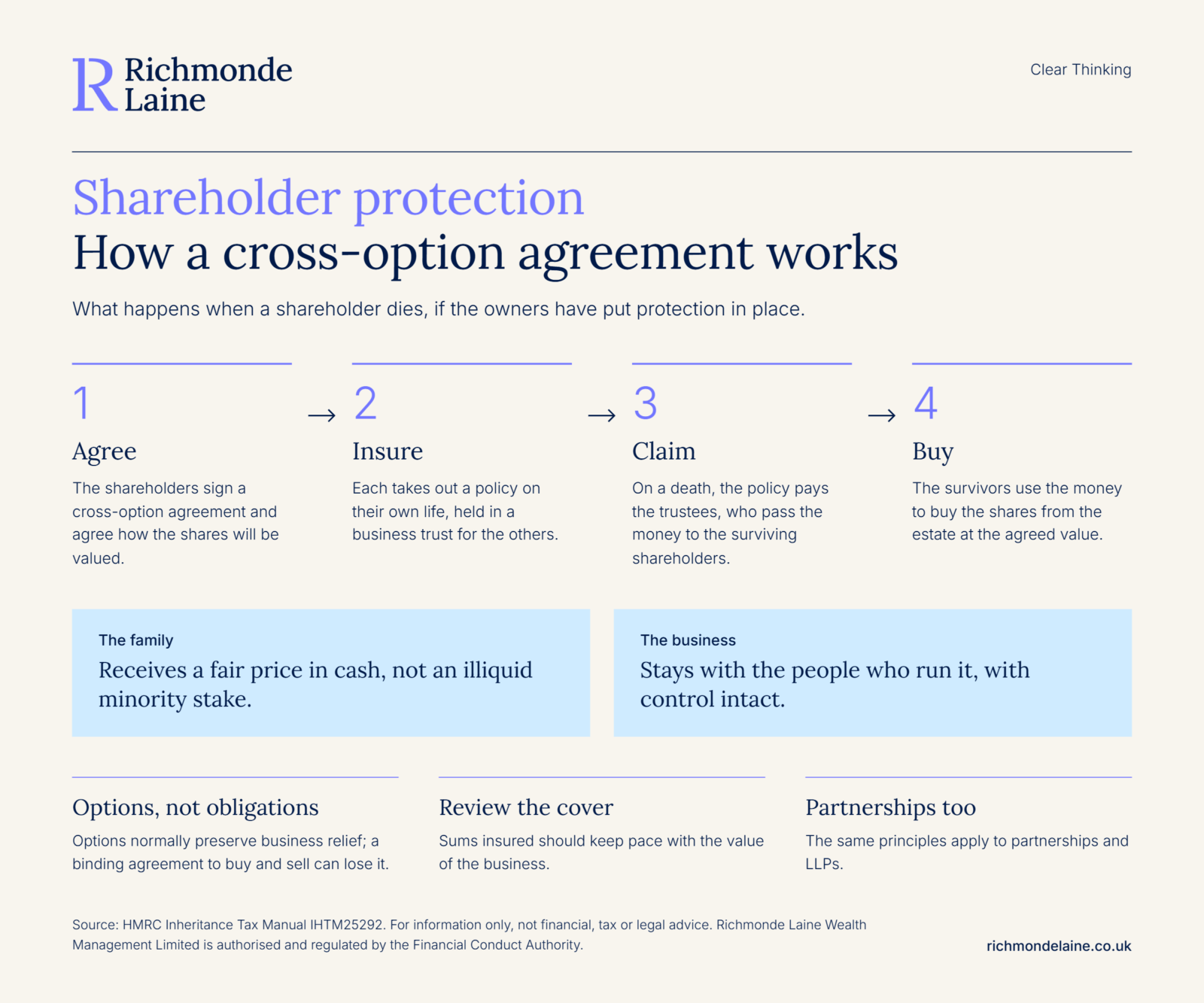
Three elements work together. The first is an agreement, usually a cross-option agreement, giving the surviving shareholders the right to buy the shares and the deceased’s estate the right to require them to do so. The second is insurance, normally life cover and often critical illness cover, sized to each owner’s stake. The third is an agreed basis for valuing the shares.
In the most common structure, each shareholder takes out a policy on their own life, pays the premiums and writes it under a business trust for the benefit of their fellow shareholders.¹ If one dies, the policy pays the trustees, who pass the money to the survivors. The survivors use it to buy the shares from the estate. The family receives a fair price in cash, and the business stays with the people who run it.
Choosing the right structure
There are four main approaches, and the right one depends on the number of owners, their ages and health, and how the business is likely to change.
- Own life under business trust: the approach described above, and the most widely used. It copes well with change, because the trust can be updated as shareholders join or leave.
- Life of another: each shareholder insures the others’ lives directly. This is simple for two owners but unwieldy for more, and awkward when someone leaves.
- Company share purchase: the company owns a policy on each shareholder and, on a death, buys back the shares itself. It keeps premiums in one place, but the company must meet the legal rules for buying its own shares, and the tax treatment of the buy-back needs checking.
- Partnership protection: for partnerships and LLPs, the partnership agreement sets out what happens to a partner’s share, supported by policies held in trust for the other partners.
The tax treatment
The wording of the agreement matters for inheritance tax. Shares in an unquoted trading company, or an interest in a partnership, usually qualify for business relief: 100% on the first £2.5 million of qualifying business and agricultural property, and 50% above that.² Relief is lost, however, if a binding contract for sale exists at death.³ HMRC treats a ‘buy and sell’ agreement, which obliges the estate to sell and the survivors to buy, as such a contract; an agreement giving options to each side is not.⁴ That is why cross-option agreements are the norm.
Policies written under a business trust pay out to the trustees, so the proceeds do not form part of the deceased’s estate. Premiums paid personally are not normally tax-deductible. Where the company pays premiums on policies that benefit the shareholders, the payments are generally taxed as remuneration or a benefit, so the funding route needs thought. The trust wording and the company’s articles both deserve specialist review.
Getting the details right
Most problems arise not from the principle but from neglect. Cover arranged when the company was worth £1 million will not fund the purchase of a stake in a business now worth £5 million. Owners should agree a valuation method, such as a formula or an independent valuation at the time, and review the sums insured regularly.
Four further points deserve attention:
- Critical illness: a seriously ill shareholder may wish to sell. Options triggered by a critical illness diagnosis can allow this.
- Unequal ages and stakes: premiums can differ widely, so some businesses equalise the cost between owners.
- Consistency: the cross-option agreement, the articles of association and any shareholders’ agreement must not contradict one another.
- Leavers: the agreement should say what happens when a shareholder retires or leaves, including what becomes of their policy.
A conversation worth having early
Shareholder protection is, at heart, an act of courtesy: to colleagues, who keep control of what they have built, and to families, who receive a fair price in cash rather than an awkward minority stake. It costs relatively little to put in place and a great deal more to do without. The best time to agree the terms is while everyone is well and on good terms; the best way to keep them useful is to revisit them as the business grows.


This article is for general information only and is not financial, tax or legal advice. Figures reflect the rules in force on 03 November 2026 and may change.
An arrangement that lets the surviving owners of a business buy a deceased or critically ill owner’s shares at an agreed value, funded by insurance. The family receives cash and the business stays with the people who run it.
No. Key person cover pays the company to offset lost profits or recruitment costs when an important individual dies or falls ill. Shareholder protection funds the purchase of shares. Many businesses need both.
Usually not. Premiums on own-life policies paid personally receive no relief, and where the company pays premiums that benefit the shareholders, the payments are generally taxed as remuneration or a benefit.
Normally not. HMRC accepts that an agreement giving options to each side is not a binding contract for sale, so business relief is preserved. An agreement obliging both sides to buy and sell would lose it.⁴
Enough to buy each owner’s stake at its current value. Agree how the shares will be valued and review the sums insured whenever the business’s value changes materially.
Policies can include critical illness cover, and the agreement can give options that are triggered by a diagnosis. That allows an ill owner to sell and the others to buy.
The agreement should say. With own-life policies under a business trust, the trust can usually be updated to reflect the new ownership, but what happens to the leaver’s policy depends on its terms.
Yes. Partnership protection works on the same principles, with the partnership agreement setting out what happens to a partner’s share and how it is paid for.
Sources & Notes
1. Legal & General, Shareholders’ cross option agreement (W13232), June 2024.
2. Ross Martin, Business Property Relief: at a glance.