
Key takeaways
Tax now follows profit closely: basis period reform ended the long deferral; remaining transition profits are taxed by 2027-28, or on retirement if sooner.
Reserves need checking: firm tax retentions may not cover estimated returns, and late payment interest is costly.
Capital is at risk: partner capital is usually borrowed, illiquid and tied to a single firm.
Pension allowances are small: above £360,000 of adjusted income, the annual allowance falls to £10,000.
Protection is personal: there is no employer sick pay or death-in-service cover to fall back on.
Plan the exit early: the retirement date affects tax, and capital left as a loan loses business property relief.
Introduction
An equity partner in a law firm occupies a curious position in British professional life. By most measures a senior lawyer at the summit of a demanding career, in the eyes of HMRC a partner is simply self-employed: a trader who happens to practise law. The rewards can be considerable, and at the largest firms remarkable. But they come without the scaffolding most high earners take for granted — no salary, no employer pension, no sick pay, and a tax bill that has traditionally trailed well behind the income it relates to.
That makes personal financial planning both more important and more intricate than for an employee on similar pay. The tax system has not stood still either. Basis period reform has pulled partners’ tax forward, the pension taper bites hard at partner-level profits, and inheritance tax is changing shape.¹ What follows sets out the questions that matter most for equity partners, and the order in which to tackle them.
What sets equity partners apart?
Most equity partners share a recognisable financial profile, and each trait carries a planning consequence.
- Self-employed status. Partners are taxed on their share of profits rather than paid a salary, and pay Class 4 rather than Class 1 national insurance.
- High, variable income. Profit shares rise and fall with the firm’s results and, under merit-based systems, with individual performance.
- Capital at stake. New equity partners usually contribute capital, often funded by a loan arranged through the firm’s bank.
- No employer benefits. There is no employer pension, sick pay or death-in-service cover unless the firm arranges it.
- Concentration. Income, capital and professional reputation are all tied to one firm.
- Little spare time. Demanding practice leaves little room for personal finances, so decisions are often made late.
This article concerns equity partners. Fixed-share partners may be taxed as employees under the salaried member rules, which changes much of what follows.
Tax: higher, sooner and harder to predict
Equity partners pay income tax at up to 45% on their share of profits, plus Class 4 national insurance at 2% above £50,270: a top marginal rate of 47%. Between £100,000 and £125,140, the withdrawal of the personal allowance creates an effective rate of 62%, which matters most for newer partners whose profits sit near that band.
The bigger change is timing. Partners in firms with an April year-end were once taxed on profits almost a year after earning them. Basis period reform moved everyone to a tax-year basis from 2024-25, and the extra transition profits this created are spread over the five years to 2027-28.¹ Where a firm keeps a non-March year-end, partners must file on estimated profits and amend their returns later.¹
Politics adds uncertainty. Charging something like employer national insurance on partnership profits was considered and rejected in 2025, and John Healey’s first Budget, on 28 October 2026, did not revive it.² Partners would be unwise to treat the question as closed.
Cash flow: drawings, reserves and the January bill
A partner’s income arrives in an unusual shape. Monthly drawings are an advance against profits; the balance follows once the accounts are finalised, sometimes many months later. Most firms retain part of each partner’s share for tax and pay HMRC on the partners’ behalf in January and July.¹ That rhythm will change from April 2029, when the Budget’s reforms require those who make payments on account to pay smaller, more frequent instalments during the year.²
Those reserves were built for the old timetable. Basis period reform brought tax forward and thinned firms’ reserves, and where estimated returns prove too low, late payment interest — recently between 7% and 8.5% — mounts quickly.¹ Some firms may ask partners to meet shortfalls personally.¹ A partner who assumes the firm has the tax in hand should check exactly what it has reserved.
The personal answer is a cash buffer held outside the firm, large enough to cover a shortfall in reserves, a lean year’s drawings and any capital call. Treating each year’s balancing payment as a windfall, rather than as money that may be needed for tax or capital, is a common and avoidable mistake.
Partner capital: borrowed, illiquid and at risk
Becoming an equity partner usually means buying in, and many partners fund their capital contribution with a loan arranged through the firm’s bank. Interest on a loan used to buy into a partnership, or to lend to it, can qualify for income tax relief. The relief counts towards the cap on certain reliefs, set at the greater of £50,000 or 25% of adjusted total income.³
The capital itself typically earns little or no return and cannot be withdrawn while the partner remains. It is repaid on departure, often in instalments, and only if the firm can afford it. Law firm failures are rare but not unknown, and in an insolvency partners’ capital ranks behind the firm’s creditors.
A sensible plan treats partnership capital as an illiquid, undiversified asset rather than as savings. Paying down the capital loan early can be tempting; whether it is wise depends on the interest rate, the tax relief and how much liquidity the partner holds elsewhere.
Pensions: generous relief, meagre allowance
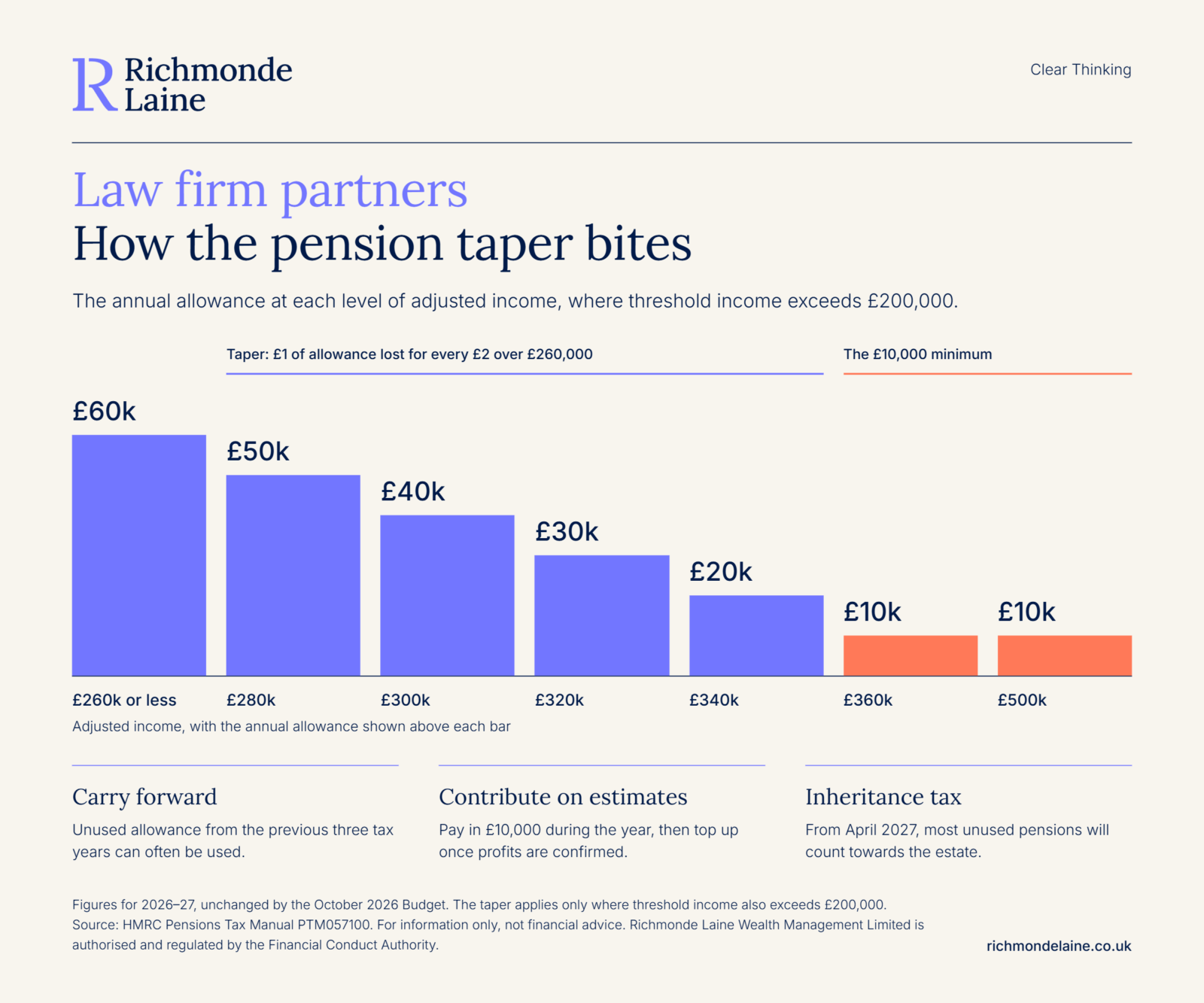
Without an employer scheme, a partner’s pension is entirely self-funded, though personal contributions attract relief at up to 45%. The constraint is the tapered annual allowance. Where threshold income exceeds £200,000 and adjusted income exceeds £260,000, the £60,000 allowance falls by £1 for every £2, reaching a floor of £10,000 at £360,000.⁴ Many equity partners sit at or near that floor.
Timing compounds the problem. Profit shares are often confirmed only months after the year-end, so partners must contribute on estimates. A prudent approach is to pay in the £10,000 minimum during the year, then top up once profits are known, using unused allowances carried forward from the previous three tax years.
The pension’s role in the estate is also changing. From 6 April 2027, most unused pension funds and death benefits will count towards the estate for inheritance tax.⁵ Pensions remain valuable for retirement income, but less so as a way of passing on wealth.
Protection: replacing the employer's safety net
Employees rarely think about sick pay or death-in-service benefits because their employer provides them. Partners must arrange their own. Some firms offer group cover for partners, but it is often modest relative to profit share and usually ends on leaving.
Income protection is the priority. A serious illness can stop drawings long before any partnership provision for incapacity helps, while fixed costs — mortgage, school fees, capital loan interest — carry on. Policies typically replace only part of pre-tax income, and definitions of incapacity vary, so the detail matters. Life cover should reflect debts, including the capital loan, and the family’s needs; written in trust, it can pay out quickly and outside the estate.
The partnership agreement deserves a careful read too. It governs what happens to profit share and capital on long-term illness or death, and the answers are not always generous.
Retirement and succession: leaving well
For a partner, retirement is a legal event with tax consequences, not simply a change of routine. Any transition profits not yet taxed are brought into charge in the year of retirement, and the chosen date can move income between tax years, so it pays to model the alternatives before committing.¹ Payments on account based on a final full year of profits may also need reducing.
Capital needs attention too. While a partner remains in the firm, an interest in the partnership generally qualifies for business property relief from inheritance tax, now at 100% on the first £2.5 million of combined business and agricultural property.⁶ ⁷ Capital left in the firm as a loan after retirement does not qualify.⁷
Many partners continue as consultants, which softens the drop in income. Throughout, the aim is the same: decide the order in which capital, pensions and other savings will fund retirement, and how whatever remains will pass on.
Making the partnership pay
Equity partners spend their careers guiding clients through complex, high-stakes decisions. Their own finances deserve the same rigour. The partnership model brings real rewards, but it also concentrates risk, blurs the line between business and household money, and leaves each partner to build the protections an employer would otherwise provide. A plan that sets tax reserves, capital, pensions and protection side by side — revisited each year when the profit share is confirmed — is the surest way to make a partnership pay.


Equity partners are self-employed. They are taxed on their share of the firm’s profits rather than a salary, at income tax rates of up to 45%, plus Class 4 national insurance at 2% on profits above £50,270. Tax is paid through self-assessment, usually in January and July, though more frequent in-year payments are due to start in April 2029.
Since 2024-25, partners have been taxed on profits for the tax year rather than the firm’s accounting year. The extra transition profits created by the switch are spread over the five years to 2027-28, and any balance is taxed on retirement.¹
The annual allowance is £60,000, but it tapers where threshold income exceeds £200,000 and adjusted income exceeds £260,000, falling to £10,000 once adjusted income passes £360,000. Unused allowance from the previous three tax years can often be carried forward.⁴
Interest on a loan used to buy into a partnership, or to lend money to it, can qualify for income tax relief. The relief is subject to the cap on certain reliefs: the greater of £50,000 or 25% of adjusted total income.³
It is usually repaid under the terms of the partnership agreement, often in instalments. Until then it remains exposed to the firm’s fortunes, and capital left as a loan after retirement no longer qualifies for business property relief.⁷
Usually, yes. Partners have no employer sick pay, and drawings can stop quickly if they cannot work. Income protection, checked against the firm’s own incapacity provisions, helps cover fixed costs such as a mortgage, school fees and capital loan interest.
Even where the firm retains tax, a personal buffer is prudent. Estimated returns, changes in profit share and interest on late payment can all produce unexpected bills, and firms may ask partners to settle shortfalls personally.¹
Ideally five years or more ahead. That leaves time to use pension carry forward, choose a retirement date with transition profits in mind, plan how capital will be repaid and consider how business property relief and pensions fit the estate plan.
Sources & Notes
1. Crowe UK, Basis Period Reform: current status, 12 May 2026.
2. PKF Francis Clark, What tax changes might John Healey introduce in his Budget on 28 October?, September 2026; HM Treasury, Budget 2026: overview of tax legislation and rates, 28 October 2026.
3. HMRC, HS340 Interest eligible for relief on qualifying loans (2026), updated 6 April 2026.
5. HMRC, Inheritance Tax on pensions: technical note, updated 29 May 2026.
7. Ross Martin, Business Property Relief: at a glance.