
Key takeaways
Start early: the best tax planning happens years before a buyer appears, not after heads of terms are signed.
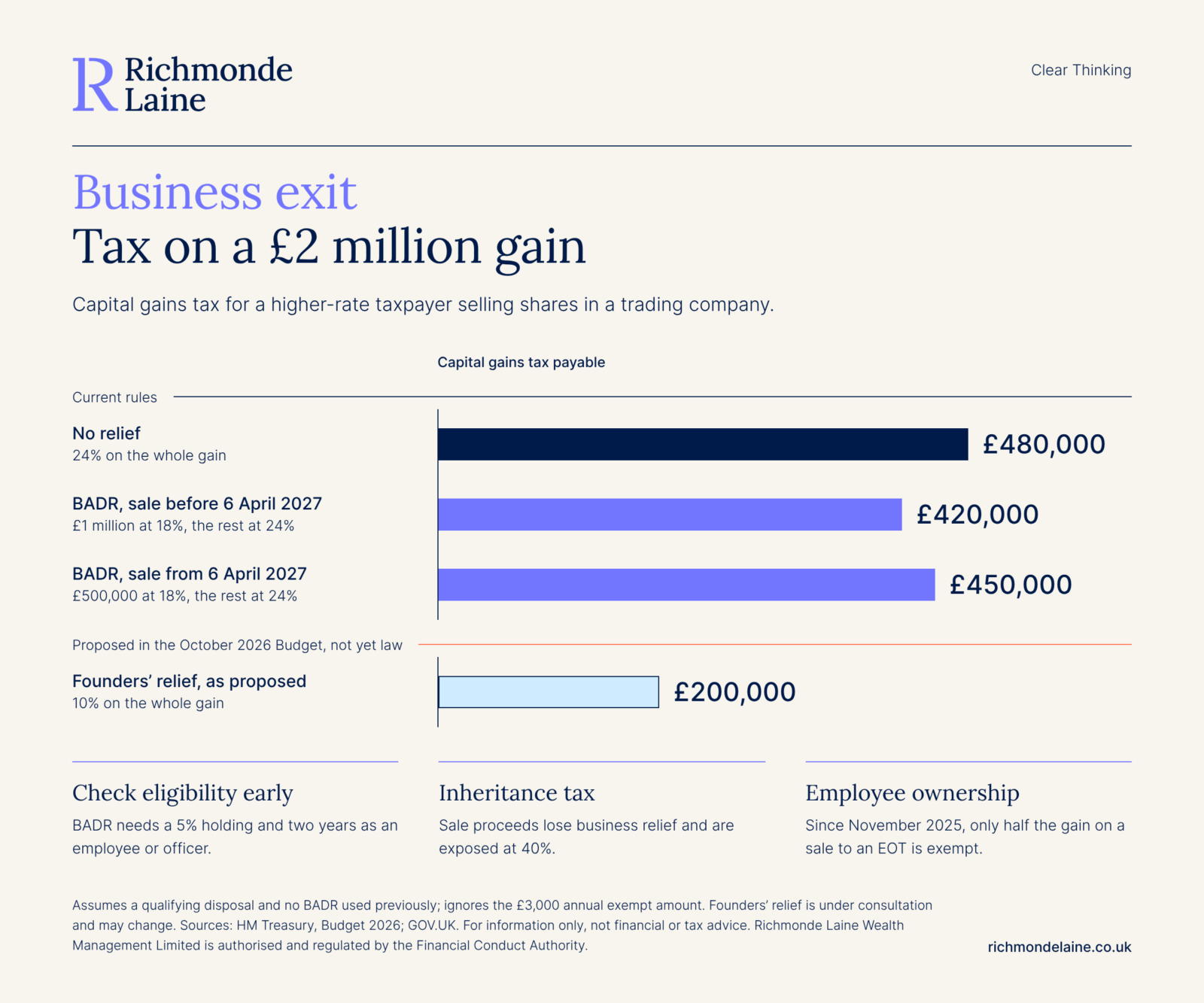
BADR is shrinking: the 18% rate applies to £1 million of lifetime gains until 5 April 2027, and to £500,000 after that.
Founders’ relief is only proposed: a 10% rate on up to £10 million of gains is under consultation and is not yet law.
The route changes the tax: a share sale, management buy-out or employee ownership trust each produce different outcomes.
Cash loses inheritance tax relief: sale proceeds no longer qualify for business relief, so estate planning should start before completion.
Plan for life afterwards: pensions, investments and cashflow modelling turn a one-off payment into lasting financial security.
Introduction
For most business owners, selling the company is the largest financial transaction of their lives, and often the only one of its kind. It is the moment when years of effort, risk and sacrifice are finally turned into something that can fund a retirement, support a family or seed the next venture. It is also the moment when the tax system takes the closest interest.
The rules are shifting beneath sellers’ feet. The lifetime limit for Business Asset Disposal Relief halves to £500,000 from April 2027,¹ while a proposed founders’ relief, still under consultation, would tax qualifying gains at 10%.² Inheritance tax adds a further twist, because shares that qualify for relief become ordinary cash once sold. What follows sets out how to plan an exit that keeps as much of the reward as the rules allow.
When to start planning
Exit planning repays early attention. It is most valuable for:
- Owners three to five years from a sale: with time to meet relief conditions and restructure if needed.
- Family businesses: weighing a sale against passing the business to the next generation.
- Owners considering a management buy-out or employee ownership: where the buyers’ ability to fund the deal shapes its structure.
- Founders relying on the sale for retirement: for whom the after-tax proceeds must last for decades.
- Serial entrepreneurs: who may already have used part of their lifetime reliefs.
The shared risk is that decisions made in the rush of a transaction are hard to undo once the sale has completed.
Capital gains tax and BADR
A sale of shares is normally taxed as a capital gain. Higher and additional-rate taxpayers pay 24% on gains above the £3,000 annual exempt amount.³ Business Asset Disposal Relief reduces the rate to 18% on qualifying gains for disposals from 6 April 2026.⁴
To qualify on a sale of shares, the seller must generally have held at least 5% of the shares and voting rights, with matching economic rights, and been an employee or officer of a trading company, for at least two years before the sale.⁴ These conditions are easy to fail by accident: a share issue that dilutes a holding below 5%, or a gradual drift into non-trading investment, can remove the relief just when it is needed. Checking them well before a sale leaves time to put things right.
What is changing
The October 2026 Budget changed the arithmetic for many sellers. The BADR lifetime limit falls from £1 million to £500,000 for disposals on or after 6 April 2027.¹ On a £2 million gain, the tax saving from the relief halves from £60,000 to £30,000.
At the same time, the government proposed a new founders’ relief, taxing qualifying disposals of shares at 10% up to a £10 million lifetime limit from April 2027.² The consultation closes on 30 November 2026, and the conditions are not yet known. Sellers should therefore treat it as a possibility, not a plan. Timing a sale purely around tax is rarely wise, but owners close to a deal should understand how each date would affect them.
Choosing the route
The type of sale shapes the tax as much as the price.
- Trade sale of shares: usually the simplest for the seller, with any gain taxed as above.
- Management buy-out: often funded partly by deferred payments, which affects both risk and timing.
- Employee ownership trust: since 26 November 2025, only half the gain on a sale to an employee ownership trust is exempt, and BADR cannot be claimed on the rest.⁵
- Company purchase of own shares: can return value to a departing shareholder, but must meet strict conditions to be taxed as capital rather than income.
Deal structure matters too. Fixed deferred consideration is usually taxed when the sale completes, even though the cash arrives later. Earn-outs are generally taxed as capital, but payments linked to continued employment can be treated as income.
From relief to exposure: inheritance tax
While owned, shares in an unquoted trading company usually qualify for business relief from inheritance tax: 100% on the first £2.5 million of qualifying business and agricultural property, and 50% above that.⁶ The moment they are sold, that protection ends. The proceeds become cash or investments, exposed to inheritance tax at 40%.
This makes the period before a sale an important window for estate planning. Gifts of shares to family members or into trust, made well before a sale is agreed, can move future growth out of the estate while relief still applies. Once a binding contract for sale exists, relief is lost, so timing is critical. Gifts of shares can also trigger capital gains tax, although relief to defer it is often available for business assets.
Before and after the sale
Several steps can improve the outcome before completion. Employer pension contributions, within the annual allowance and any unused allowance carried forward, can extract value from the company tax-efficiently. Where a spouse is genuinely involved in the business, their own shareholding may bring a second BADR allowance. Surplus cash in the company may affect both the price and the relief, and is worth reviewing early.
After the sale, the task changes from maximising value to preserving it. A large sum in the bank invites hasty decisions. Cashflow modelling can show how much is needed to fund the life the owner wants, how much can be given away and how the rest should be invested. For many owners, the hardest part of an exit is not the deal itself but deciding what comes next.
The exit after the exit
A well-planned exit is measured not only by the price achieved but by what remains afterwards, and by whether it funds the life the owner hoped for. The reliefs available are changing, the routes to market carry different tax costs, and inheritance tax becomes a live issue the moment shares turn into cash. Owners who start early, check their eligibility for relief and plan for life after the sale tend to keep far more of what they have built. The best time to begin is before a buyer comes calling.
18% on qualifying gains up to your Business Asset Disposal Relief lifetime limit, if you meet the conditions, and 24% above that for higher and additional-rate taxpayers.³ ⁴
Up to £1 million of qualifying gains over your lifetime, falling to £500,000 for disposals on or after 6 April 2027.¹
A relief proposed in the October 2026 Budget that would tax qualifying share disposals at 10%, up to a £10 million lifetime limit, from April 2027. The consultation closes on 30 November 2026 and the details may change.²
A sale completing before 6 April 2027 can use the larger BADR limit, worth up to £30,000 more in tax saved. But the founders’ relief proposal may change the picture, and a sale should rarely be rushed for tax reasons alone.
Usually as capital, where they are genuinely part of the price for the shares. Payments that depend on the seller continuing to work in the business can be taxed as income.
Shares in a trading company usually qualify for business relief, but the cash from a sale does not, so the proceeds become exposed to inheritance tax at 40%.⁶
Less than before. Since 26 November 2025, only half the gain is exempt, and the rest is taxed without Business Asset Disposal Relief.⁵ An employee ownership trust can still suit owners who value continuity and the company’s culture.
Ideally three to five years before a sale. That leaves time to meet relief conditions, restructure if needed, make pension contributions and plan for inheritance tax.


This article is for general information only and is not financial, tax or legal advice. Figures reflect the rules in force, and Budget announcements made, as at 3 November 2026. Founders’ relief is a proposal and may change or not be introduced.
Sources & Notes
1. HM Treasury, Budget 2026: overview of tax legislation and rates, 28 October 2026.
2. Macfarlanes, The Autumn Budget 2026, 28 October 2026.
3. HMRC, Capital Gains Tax rates and allowances, updated 13 April 2026.
4. GOV.UK, Business Asset Disposal Relief: eligibility.
6. Ross Martin, Business Property Relief: at a glance.